Andrew Huberman on Retatrutide: What He Said and What the Data Shows
Editorially reviewed · Last updated September 9, 2026 · How we review
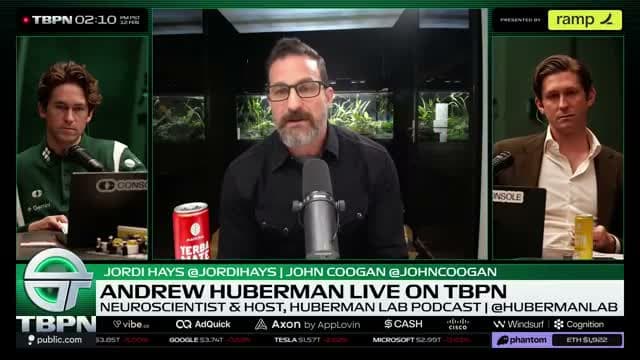
 Andrew Huberman discussed retatrutide at length during a podcast interview titled "The Peptide That Changes Everything." Huberman — a professor of neurobiology at Stanford School of Medicine and host of the Huberman Lab podcast — described retatrutide as the most significant peptide in development, called it a potential "trillion dollar drug," and discussed its implications for weight loss, bodybuilding, alcohol consumption, and regulation.
Update — June 2026: The Huberman Lab Peptides Episode (Dr. Abud Bakri)
"Retatrutide is very effective at fat loss — much more effective than semaglutide or tirzepatide, and way less side effects."
— Dr. Abud Bakri, Huberman Lab (June 1, 2026)
Neither comparative claim is established by the separate trials cited here. They report different populations, durations and treatments. A direct comparison is needed to establish superiority or fewer side effects.
| Claim | Published Data | Verdict |
|---|---|---|
| More effective at fat loss than semaglutide / tirzepatide | Retatrutide -28.7% at 12mg (TRIUMPH-4, 68wk) vs tirzepatide ~-20-23% (SURMOUNT-1) and semaglutide ~-15% (STEP 1) | Higher averages in selected separate trials do not establish head-to-head superiority. |
| "Way less side effects" | Nausea up to 43% and a new dysesthesia signal (20.9% at 12mg) in TRIUMPH-4; GI adverse events are dose-dependent and comparable to or higher than other incretins | Not established by these separate trials. Retatrutide has gastrointestinal adverse events and dysesthesia; the cited data do not isolate a tolerability advantage. |
| Triple agonist / "GLP-3" (GLP-1 + GIP + glucagon) | Confirmed mechanism in all published trials | Accurate — this is the defining feature of the drug. |
| Lilly pursuing biologic classification; 39 of ~40 amino acids | Retatrutide is a 39-amino-acid peptide; the US biologic threshold for a "protein" sits at 40+ amino acids | Plausible and a real regulatory nuance — retatrutide sits one residue below the line. |
The Triple Agonist Mechanism and Weight Loss
Huberman described retatrutide as a triple agonist of the GLP-1, glucagon, and GIP receptors, and noted that it is sometimes referred to as "GLP-3." He made a striking claim about the weight loss data:
"In a phase three clinical trial in humans, it caused up to one-third loss of body weight. A loss of one-third of body weight in about 6 months time. And it seems like there's some degree of muscle sparing."
— Andrew Huberman
This is broadly accurate on the weight loss figure but overstates the speed and simplifies the muscle data. Here is how his claims compare to the published results:
| Claim | Published Data | Context |
|---|---|---|
| Up to one-third body weight loss | 28.7% at 12mg in TRIUMPH-4 (Phase 3); 24.2% at 12mg in Phase 2 | 28.7% is close to one-third. Phase 2 topped at ~24%. |
| In about 6 months | Phase 2: 48 weeks (~11 months). TRIUMPH-4: 68 weeks (~16 months) | The timeframe is significantly longer than 6 months in both trials. |
| Some degree of muscle sparing | DXA substudy: fat-to-lean loss ratio similar to semaglutide and tirzepatide | Total fat mass loss of -26.1% at 8mg. Lean mass loss proportional to total weight loss — not uniquely muscle-sparing vs other GLP-1 drugs. |
The Bodybuilding Community and Early Adoption
Huberman described a specific adoption pipeline — from bodybuilders to gym-going physicians to high-end clients to Hollywood to the general public:
"The bodybuilding community has been onto this for a long time. Bodybuilders always get there first. Then what happens is in Florida and the United States, doctors who work out in gyms with people who know how to gain muscle and lose fat quickly start experimenting. Then it goes into their high-end clients. Then it shows up in Hollywood."
— Andrew Huberman
He noted that people are already taking retatrutide at roughly a third of the clinical trial dose and reporting significant fat loss results. Anecdotally, bodybuilding communities report using 1–4mg per week (compared to the 12mg dose in Phase 3 trials), though no peer-reviewed data exists on sub-clinical dosing outcomes.
This is consistent with what is happening in practice, but it carries serious risks. Grey market retatrutide is unregulated and untested — vendors sell it as "research chemicals" with no pharmaceutical-grade quality assurance. Contamination with lipopolysaccharide (LPS) and other impurities is a documented concern. In January 2025, the FDA froze new peptide compounding nominations, and by February 2026 enforcement against non-FDA-approved GLP-1 drugs has escalated significantly.
"A Trillion Dollar Drug"
Huberman's most headline-worthy claim was about retatrutide's market potential and the regulatory dynamics around peptide access:
"This is going to be a trillion dollar drug. Trillion dollar. But people are already taking it... The reason why peptides might soon become illegal to purchase through even compounding pharmacies, let alone gray market, is because Lilly would like to protect the domain over that patent."
— Andrew Huberman
On the regulatory point, Huberman is correct that the regulatory landscape has tightened. Compounded semaglutide and tirzepatide were banned in May 2025, and the FDA has been escalating enforcement against grey market peptide vendors throughout 2025–2026.
Beyond Weight Loss: Alcohol, Impulsivity, and the Brain
Huberman highlighted the neurological effects of GLP-1 receptor agonists beyond metabolism:
"Reduced alcohol appetite, reduced impulsivity perhaps. Remember that the receptors for these things are all over the brain and body. The other GLP agonists have been looked at for alcohol use disorder, for binge eating disorder, and for a lot of behavioral and impulse control disorders."
— Andrew Huberman
 JAMA Psychiatry (February 2025) found that semaglutide users achieved zero heavy drinking days at twice the rate of placebo (40% vs 20%) and drank half the amount in controlled lab sessions. A separate retrospective study found semaglutide users had a 56% lower risk of new alcohol use disorder diagnoses. The mechanism appears to be GLP-1 receptor activation in the brain's reward pathways, which attenuates dopamine release in the nucleus accumbens and reduces the reward signal from alcohol.
On binge eating, a meta-analysis of five studies found GLP-1 agonists improved Binge Eating Scale scores by -8.14 points, with 81% of liraglutide-treated patients shifting to the "non-binge" category.
For retatrutide specifically, one preclinical rat study (Windram et al., 2025) has shown it blunts subjective alcohol effects — but no human data exists yet.
Age, Risk, and the "Looks-Maxing" Warning
Huberman's most cautionary comments concerned young people using peptides without understanding the risks:
"The whole looks-maxing phenomenon is really, really dangerous and foolish, especially in people younger than 40... If you're augmenting growth hormone in your teens, your 20s, you can really mess up your hypothalamic-pituitary-body axis, all the organs of your body in major ways."
— Andrew Huberman
He also raised the fundamental trade-off between vitality and longevity — noting that substances which enhance muscle growth, recovery, and fat loss may also accelerate aging through elevated growth hormone and IGF-1 signalling.
Frequently Asked Questions
What did Andrew Huberman say about retatrutide?
In a 2026 podcast interview, Huberman called retatrutide "the peptide that's going to change everything" and described it as a triple agonist of GLP-1, glucagon, and GIP receptors. He discussed its weight loss potential (claiming up to one-third body weight loss), the bodybuilding community's early adoption, its market potential as a "trillion dollar drug," effects on alcohol appetite and impulsivity, and risks associated with young people using peptides. He did not endorse or recommend taking retatrutide.
Did Andrew Huberman endorse retatrutide?
No. Huberman discussed retatrutide at length and clearly found the data compelling, but he explicitly did not endorse or recommend it. He stated he has never tried it himself. His broader message was "do as you wish but know what you're doing," with a strong caution against young people and unregulated sourcing. His discussion was informational and analytical, not a product endorsement.
Is retatrutide really a trillion dollar drug?
Huberman called retatrutide "a trillion dollar drug." As a literal drug revenue figure, that is hyperbolic — no single drug has achieved a trillion dollars in annual sales. However, Eli Lilly's existing GLP-1 franchise generated $36.5 billion in 2025, analysts project retatrutide could add $15+ billion annually, and the combined obesity drug market is projected to reach $101 billion in peak annual sales. Eli Lilly itself became the first trillion-dollar pharma company by market cap in 2026.
Was Huberman accurate about retatrutide weight loss?
Partly. He claimed "up to one-third loss of body weight in about 6 months." The weight loss figure is close — TRIUMPH-4 showed 28.7% at 12mg, which approaches one-third. However, the timeframe is significantly off: Phase 2 was 48 weeks (about 11 months) and TRIUMPH-4 was 68 weeks (about 16 months), not 6 months. His claim about muscle sparing is more nuanced than he suggested — DXA data shows the fat-to-lean loss ratio is similar to other GLP-1 drugs, not uniquely better.
Is it safe to buy retatrutide after hearing Huberman discuss it?
Retatrutide is not FDA-approved and cannot be legally purchased as a medication. Grey market retatrutide sold as "research chemicals" is unregulated, potentially contaminated, and carries serious risks including impurities like lipopolysaccharide (LPS). The FDA has been escalating enforcement against non-approved GLP-1 drugs. The only way to access pharmaceutical-grade retatrutide is through clinical trial enrollment. Huberman himself noted the risks of grey market sourcing in his discussion.
What podcast did Huberman discuss retatrutide on?
Huberman has discussed retatrutide twice. First on a guest interview titled "The Peptide That Changes Everything" in early 2026 (retatrutide segment at approximately 14:15). Then on his own Huberman Lab podcast on June 1, 2026, in the episode "Peptides: The Science, Uses & Safety" with Dr. Abud Bakri, where the retatrutide discussion begins at 2:33:53. Across both he covered the drug's mechanism, weight loss data, bodybuilding adoption, market potential, effects on alcohol and impulsivity, and safety.
Did Dr. Abud Bakri say retatrutide has fewer side effects than Ozempic or Mounjaro?
Yes — on the June 1, 2026 Huberman Lab episode, Dr. Abud Bakri said retatrutide is "much more effective than semaglutide or tirzepatide, and way less side effects." The efficacy claim is supported (retatrutide's -28.7% at 12mg is the largest weight loss in the class), but the "way less side effects" claim is not. In the TRIUMPH-4 Phase 3 trial, nausea reached up to 43% at 12mg and retatrutide carried a new dysesthesia (altered skin sensation) signal of 20.9% at 12mg — a side effect not seen with semaglutide or tirzepatide. Its gastrointestinal side-effect burden is dose-dependent and comparable to the rest of the GLP-1 class, not lighter.
Sources
- Huberman, A. (2026). "The Peptide That Changes Everything." YouTube interview. Watch on YouTube
- Huberman Lab & Bakri, A. (2026). "Peptides: The Science, Uses & Safety." Huberman Lab podcast, June 1, 2026. Episode page
- Jastreboff, A.M., et al. (2023). Triple-Hormone-Receptor Agonist Retatrutide for Obesity — A Phase 2 Trial. New England Journal of Medicine. DOI: 10.1056/NEJMoa2301972
- Eli Lilly and Company. (2025). Lilly's retatrutide achieved significant weight loss and pain relief in adults with obesity and knee osteoarthritis. Press release
- Phase 2 body composition sub-study (DXA data). The Lancet Diabetes & Endocrinology. (2025).
- Semaglutide and alcohol use disorder RCT. JAMA Psychiatry. (2025).
- What this is
- Educational information, not medical advice. It reports published research — it doesn’t recommend that you use, obtain, or supply anything.
- Regulatory status
- Retatrutide and similar peptides are investigational — not approved by the FDA or any regulator. Semaglutide and tirzepatide are prescription-only medicines, available only through a licensed prescriber.
- Our standard
- Every claim traces to a primary source. We label the strength of evidence and flag estimates as estimates — never as clinical fact.
- No commercial ties
- We don’t sell, supply, or link to suppliers of any medicine, and aren’t affiliated with any manufacturer.
Do not make decisions about your health without consulting a qualified healthcare provider. For trial enrolment, see ClinicalTrials.gov. More on how we review.
Sources
- The Peptide That Changes Everything (YouTube)
YouTube
- Peptides: The Science, Uses & Safety (Dr. Abud Bakri)
Huberman Lab
- TRIUMPH-4 results
Eli Lilly
- Phase 2 trial (NEJM)
New England Journal of Medicine
 NEJM
NEJM The Lancet
 JAMA
JAMA FDA
FDA ClinicalTrials.gov
Related reading

What Is Retatrutide (GLP-3)?
Eli Lilly’s investigational triple receptor agonist: how it works, what trials show, and why GLP-3 is an informal nickname.

Retatrutide Results and Review: The Weight Loss Data by Dose
Dose-by-dose trial results, with timepoints, analysis differences and limits on predicting individual weight loss.

Retatrutide and Alcohol: What We Know
Semaglutide alcohol-use trials are promising but do not establish safe drinking or liver protection with retatrutide.

Grey Market Retatrutide: Risks, Dangers, and What You Should Know
Research labels and purity claims do not establish product equivalence, approved dosing or legal exemptions.

What to Eat on Reta: Protein, Shot Day & When You Can't Eat
Protein with a low appetite, food for injection days, groceries, fiber, and signs of under-eating, with supporting research.
Keep exploring
Explore all fact checks topics →